
 Marco Kohnsreflections11 min read
Never Feeling Good Enough: What Ten Years of Achievements Did Not Fix
A growth PM title, a Q1 paper, executive seminars: none of it made me feel enough. Where the feeling comes from, what the research says, and what changed it.
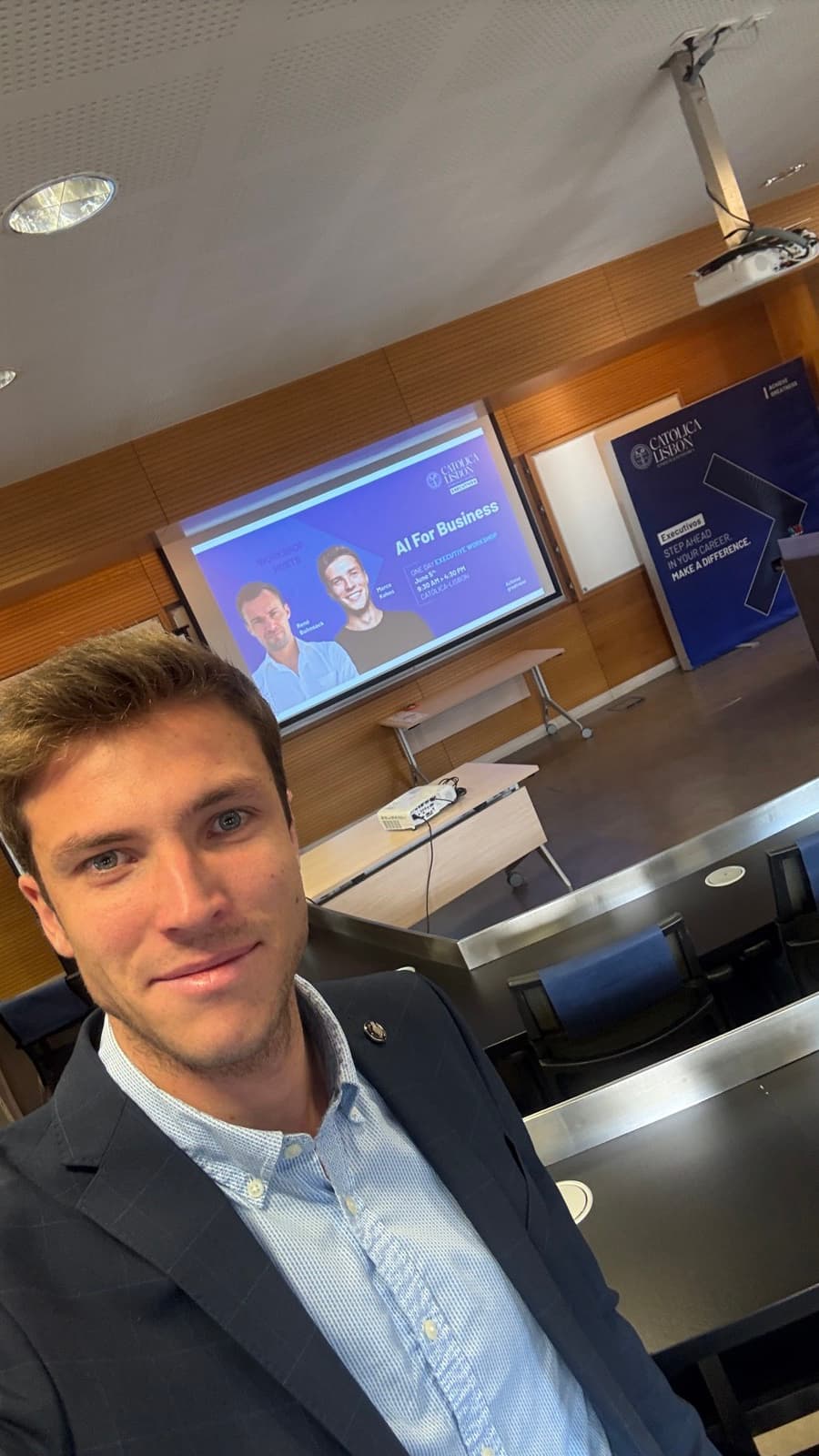
I have a list of things that were supposed to make the feeling stop. A growth product manager title at Bounce, a Series A to Series B scale-up backed by a16z and General Catalyst. A paper in the Journal of Business Research, a Q1 journal, written with a professor who is still my mentor. More than ten executive-education seminars at CATÓLICA-LISBON, in front of board members and C-level people who pay to be there. Each one, on the day I got it, was going to be the thing that finally made me feel successful. None of them did.
That is the whole finding of this essay, and I want to state it early so nobody reads on expecting a cure. The feeling of not being good enough does not respond to evidence, because it was never a measurement in the first place. It is a habit of attribution: success goes to luck and effort, failure goes to who you are. In my case it was installed before I was fifteen, by people who had no idea what they were installing. What changed it was not a title. It was repetition, a handful of adults who judged me without a file, and a written record I could not argue with.
Why does achievement not switch the feeling off?
Because the feeling and the achievement are kept in separate accounts. Success gets booked as luck, timing or effort. Doubt gets booked as identity. So the balance never moves, no matter how much you earn on the first side.
Two psychologists at Georgia State University described this mechanism in 1978, long before it had a hashtag. Pauline Clance and Suzanne Imes had worked with more than 150 highly accomplished women, PhDs and respected professionals among them, and wrote that "despite their earned degrees, scholastic honors, high achievement on standardized tests, praise and professional recognition from colleagues and respected authorities, these women do not experience an internal sense of success." They gave it the name impostor phenomenon. The sentence in that paper that stopped me was this one: "Numerous achievements, which one might expect to provide ample object evidence of superior intellectual functioning, do not appear to affect the impostor belief." One department chair in their sample told them, "Obviously I'm in this position because my abilities have been overestimated."
I recognised that sentence from the inside. When the growth team at Bounce gave me more responsibility, I filed it under "they needed someone and I worked the hours." When the paper was accepted, I filed it under "my co-authors carried it." When the first seminar went well, I filed it under "a generous audience." Each entry was plausible. Together they made a bookkeeping system in which no achievement could count.
Where did mine come from?
From school, and from a factory, and from being told the ceiling before I had tested it.
I did not make it into Gymnasium, the top tier of the German school system. I went to Realschule, partly because I questioned rules instead of following them, which German schools do not reward. In the last two years there, the school split us into a track expected to go on to university and a track that was not. I was put in the second one. I already knew I wanted to study. Nobody asked. The sorting told me something about myself that I had no way of checking, so I believed it. I have written elsewhere about the horizon a small environment draws around you; this is the part of that story that stayed inside me after I had physically left.
Then came a year in the German automotive supply industry, on a technical apprenticeship track, at sixteen. When I said out loud that I wanted to go to university one day, grown men laughed. Not cruelly, in their view. They were explaining how the world worked to someone who did not yet know.
There was one exception in those years, and he matters to the argument. A new physics and mathematics teacher arrived in ninth grade with no file on me. Every other teacher had a fixed picture, "hard to handle," and never updated it, however I behaved. He treated me like any other student, and under him I became the best in the class. Nothing about my intelligence had changed between his classroom and the one next door. Only the judgement had. That is the first piece of evidence I ever had that the feeling was about the room, not about me, and it took me another decade to believe it.
The honest root, which I only understood later, is that I pushed so hard through my bachelor's degree because I did not feel smart. From the outside that looked like ambition. From the inside it was compensation. The effort worked, and it cost more than it needed to, and I have since had to separate two beliefs I used to hold as one: extraordinary results sometimes take extraordinary effort, and you should force extraordinary effort on yourself. I still hold the first. I dropped the second.
What did the rooms teach me?
That the feeling arrives with every new room, and that it fades through repetition rather than through any single realisation.
On the first day of my internship at a performance-marketing agency in London, I walked into a room of about twenty people and, out of nerves, hit the light switch instead of opening the door. My manager had studied at Bocconi. Others had come from Oxford. A year or two earlier I had been on a factory floor, and not five years before that adults were telling me I would not study at all. Now I was debating campaign decisions daily with people whose universities I had only read about, four years after a gap year had first taken me out of the village. The sentence in my head was simple: I do not belong here.
The same sentence was waiting for me at Techstars Berlin, in a team of around ten where every person was a strong performer and, unusually, kind. I arrived certain I was the one who had slipped through. The feeling did not disappear in a moment. It thinned. Good feedback once could be luck. Good feedback for six months, from people with no reason to be generous, is harder to explain away. Barack Obama has described a version of this, and I will paraphrase rather than quote: once you sit at the table with the big names, you find they are not that extraordinary, and that you belong. I would put it less grandly. Nobody at the table is checking your school tier. They are checking whether the work is good.
One sentence from that period did more than any title. After a 6am volunteer shift at Web Summit during my master's, someone I had known for a day told me I was as smart as the Harvard graduates he knew, and that what usually separated people was resources. He had nothing to gain by saying it. That is why it stuck.

Is this just me?
No. It is common enough that the research cannot agree on how common, and it turns up at the top of organisations at least as much as at the bottom.
A systematic review in the Journal of General Internal Medicine (Bravata and colleagues, 2020) pooled 62 studies with 14,161 participants. Prevalence "varied widely from 9 to 82% largely depending on the screening tool and cutoff used." The feeling "was common among both men and women and across a range of age groups (adolescents to late-stage professionals)," is often comorbid with depression and anxiety, and is associated with impaired job performance and burnout. The review's most sobering line is its last: as of 2020, "no published studies evaluated treatments for this condition." The advice industry around this feeling is enormous. The evidence base for fixing it is close to empty.
The other dataset that changed how I think about it came from executives, not students. In 2020 KPMG surveyed 750 executive women one or two steps from the C-suite, nominated by their own CEOs to attend a leadership summit, and published the results in a press release. These are people who have, by every external measure, made it.
| Category | Percent |
|---|---|
| Have experienced imposter syndrome | 75% |
| Put more pressure on themselves not to fail than men do | 81% |
| Look to a mentor when doubting a new role | 72% |
| The more successful, the lonelier at the top | 54% |
| Never expected to reach this level of success | 47% |
Three in four executives report the feeling. Half say it grows with success, because every promotion is a new room. Source: KPMG Women's Leadership Summit Report, October 2020, 750 executive women across 150+ organisations
Look at the two highlighted bars. More than half said the feeling gets lonelier the more successful they become, because each step puts them in a new peer group. Nearly half traced their doubt to never having expected to get this far. That is my pattern, described by 750 people who have gone further than I have. The feeling does not shrink as you climb. Every room resets it, which is why the next title cannot be the cure, and why waiting for it is a plan that fails on schedule.
What worked, and what did not?
Effort did not work, or rather it worked on my career and did nothing for the feeling. Three other things did.
Repeated evidence from people without a file. The physics teacher, the Techstars team, the volunteer at 6am. What they had in common was no prior picture of me and no reason to flatter. One such person can be dismissed as kind. Several, over years, become a dataset. I did not decide to believe them. I ran out of ways not to.
A written record I could not argue with. For more than five years I have kept a weekly written reflection, the same structure every Sunday. Its value for this problem is that memory edits and the archive does not. When I go back a year, I find the week I was certain a seminar would expose me, followed three weeks later by the invitation to run the next one. I find the month I was sure the paper would be rejected, and then the acceptance. The feeling always predicts exposure. The archive shows it has been wrong every time so far. That is not a pep talk. It is a base rate. A once-a-year audit does the same job at a larger scale.
Separating the effort from the fuel. Once I understood that the drive had been compensation, I could keep the drive and change the fuel. I still work hard. I no longer work hard to prove something to a factory floor that stopped watching a decade ago. That changed my hours, and it changed how it feels to stop at the end of a day.
What did not work was waiting for the next credential. I tested that hypothesis for ten years with a growing sample of credentials, and the result was consistent.
| What I tried | Effect on the career | Effect on the feeling |
|---|---|---|
| Working harder than everyone around me | Large, and it paid for the next step every time | None. The effort was booked as proof I was compensating |
| The next title, the next paper, the next room | Large | A few days, then the room reset it |
| People with no file on me, over years | Indirect | The only thing that moved it, slowly |
| A weekly written record, five years and counting | Indirect | A base rate the feeling cannot argue with |
One more line, because it belongs here. What I am describing is a feeling, and I have written about it as one. If for you it is heavier than that, if it stops you working or sleeping, the review above is clear that it travels with anxiety and low mood, and a professional is the right next conversation, not a blog post.
What does "enough" mean now?
It means the direction is right and the present behaviour is good, judged by someone who is looking at today rather than at my file. Including me.
I have stopped expecting the feeling to end. Given the data, that would be an unusual outcome, and planning around an unusual outcome is a poor way to run a life. Instead I have changed what I do when it shows up. I check the record. I ask whether the doubt is attached to any specific piece of evidence or is just the room being new. Most of the time it is the room. Then I do the work anyway, which is the only thing that has ever made a room familiar.
Marcus Aurelius spent his private notebooks reminding himself of things he already knew, and I have written about what survives of that practice today. I used to find it odd in the most powerful man alive. I do not any more. Knowing something once does not keep it known. The feeling comes back, the notebook answers it, and the next morning you go into the room.
The room I think about most is a seminar room at CATÓLICA-LISBON, an hour before a workshop, chairs empty, the projector showing my first slide. Fifteen years earlier a school had sorted me into the group that would not go to university. The people about to arrive run companies. The feeling arrives before they do, every time. Then they come in, we work, and for a few hours it is quiet. That is what enough looks like from here: not the absence of the feeling, but knowing, from the record, which of the two of us has been right.