
 Marco Kohnsimpact7 min read
Employee Upskilling: Why Training People Beats Replacing Them With AI
The business case and the economics for upskilling employees instead of replacing them with AI, from someone who teaches AI to executives.

Klarna said AI was doing the work of 700 people. By mid-2025 it was rehiring, and research reported by Reworked found that 55% of companies that executed AI-driven layoffs regretted them. That is the case for employee upskilling in one line: replacing people with AI has been tried at scale, and some of the loudest examples were walked back within months. This article makes the business case with numbers, the economic case with evidence, and then gets practical: what an AI upskilling program looks like when it works, based on what I teach in executive-education seminars.
What Employee Upskilling Means (and What It Does Not)
Employee upskilling is teaching your existing workforce new skills so they can do more inside the roles and career paths they already have. It differs from reskilling, which prepares people for entirely different roles, and from replacement, which swaps people for technology or cheaper labour.
The distinction that matters in the age of AI: upskilling treats a new technology as a tool your people learn to wield, so the productivity gain shows up in their output. Replacement treats the technology as a substitute for them, so the gain shows up, if at all, in the payroll line.
Why Upskilling Is Important: The Numbers
The urgency and the economics both point the same way:
| What the data says | Number | Source |
|---|---|---|
| Fortune 500 CHROs who predict AI will replace roles in their company within 3 years | 72% | Gallup-Workhuman survey, n=4,439 |
| Employees who say their organization has communicated a clear AI plan | 15% | Gallup |
| Employees who strongly agree their organization encourages learning new skills | 26% | Gallup |
| How much less likely upskill-encouraged employees are to be job-hunting | 47% | Gallup |
| Average cost to hire a new employee vs. upskill an existing one | $4,425 vs. $1,300 | WEF Future of Jobs data, via IBM |
Read those together and the gap is obvious: executives expect AI to reshape roles, employees have not been told the plan, and the organizations that do invest in learning keep their people at nearly half the attrition risk, at less than a third of the cost of hiring replacements.
The Economist's Case: AI Can Automate or Augment, and Firms Choose
The deeper argument comes from economics, not HR. In Power and Progress, Nobel laureates Daron Acemoglu and Simon Johnson trace a thousand years of technology and wages to one conclusion: whether a technology enriches workers or displaces them is a design choice firms make, not a property of the technology.
"The reason that Ricardo's and Keynes's worst fears about technological unemployment did not come to pass is intimately linked to new tasks. Automation was rapid throughout the twentieth century but did not reduce the demand for workers because it was accompanied by other improvements and reorganizations that produced new activities and tasks for workers."
Acemoglu & Johnson, Power and Progress
Their NBER work makes the condition explicit: automation can raise wages, but only when it is accompanied by new tasks that raise the marginal productivity of labour. The same book documents that training low-education workers was an important pillar of shared prosperity before the 1980s. The Friedman doctrine still taught in business schools, that a company's primary responsibility is maximizing shareholder value, pushes the other way, toward booking the AI gain as a labour-cost cut.
The video below breaks down where European employment is shrinking and growing: industrial roles are being cut while technology roles are being created. New tasks, again.
What Happens When Companies Replace Instead
The replace-first strategy keeps failing in public, and the pattern is consistent across very different settings:
| Case | What was predicted | What happened | Source |
|---|---|---|---|
| Klarna | AI would do the work of 700 employees | Rehiring by mid-2025; 55% of companies that ran AI-driven layoffs regret them | Reworked |
| Human-AI teams | Pairing a human with AI beats either alone | On average the pairing beat humans alone but not AI alone; it helped on content-creation tasks and hurt on decision-making tasks | MIT Sloan |
| Toyota production | Maximum automation maximizes output | Jidoka, "automation with a human touch": machines and robots "can't evolve any further on their own. Only humans can implement kaizen" | Toyota |
| Radiologists | "Stop training radiologists now" (Geoffrey Hinton, 2016) | US diagnostic radiology residencies offered a record 1,208 positions in 2025; average income up 48% since 2015 | Works in Progress |
The MIT Sloan finding deserves the emphasis, because it cuts both ways: humans plus AI is not automatically the stronger combination either. The split between what people do and what the model does has to be designed deliberately, task by task. Radiology shows what that looks like when it is done well: in a large retrospective study of 1.19 million screening mammograms, a decision-referral approach where AI handled confident cases and referred the rest to radiologists beat both the individual radiologist and the standalone AI on sensitivity and specificity.
Y Combinator discusses a version of the same argument in the video below. My reading of it: AI cuts some jobs, and it also drives down costs, which drives demand, which creates more emerging work, with humans in the loop.
Upskilling Employees on AI: What I See Teaching Executives
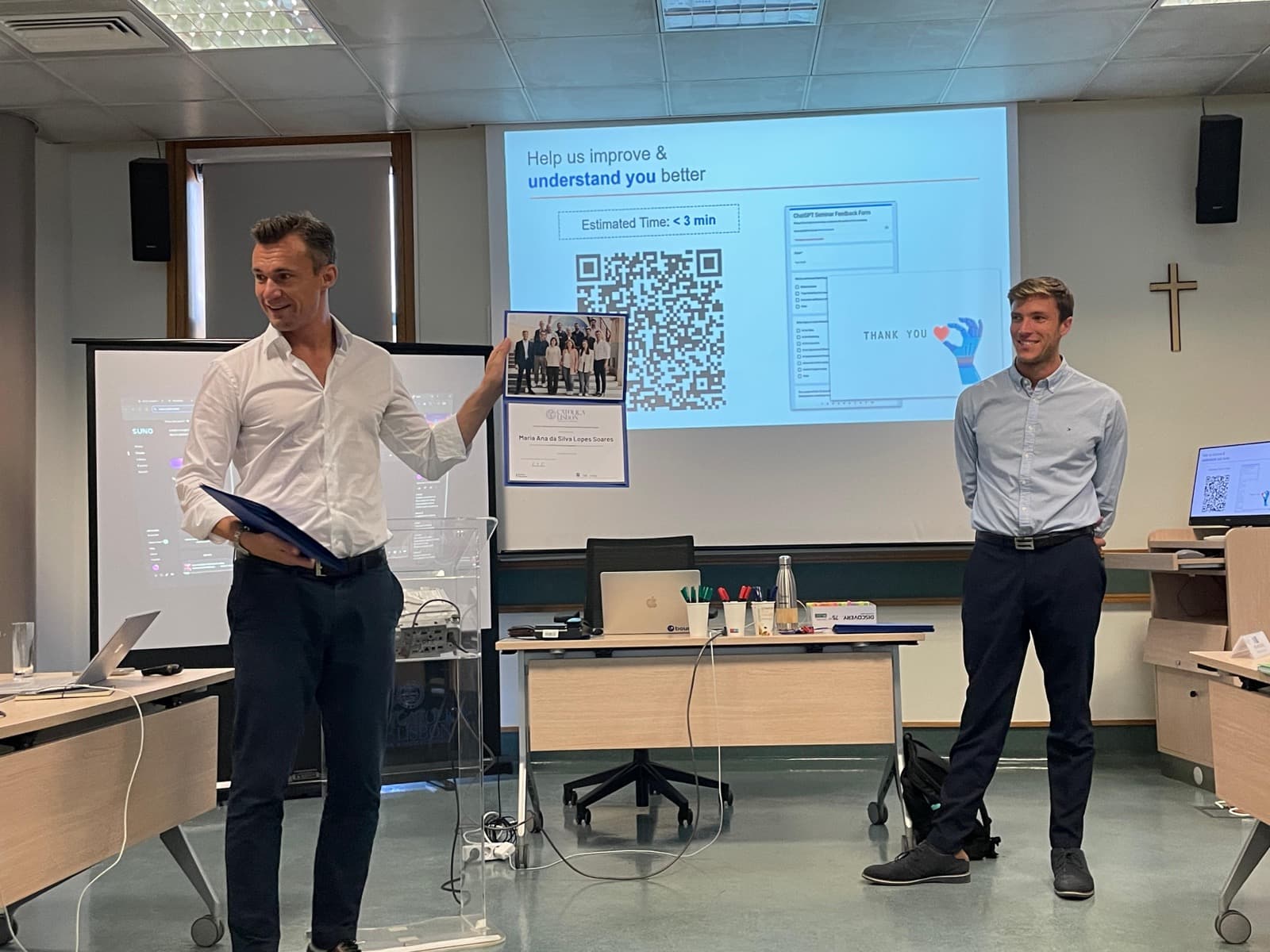
I have delivered 10+ executive-education seminars on AI for business development at Católica Lisbon and across Europe, to C-level audiences and board members, and taught 1,500+ students online. My peer-reviewed research on generative AI, published in the Journal of Business Research and revisited three years after the interviews, reached the same conclusion the economics above points to: generative AI is a way to run more experiments with the same team, not a replacement for judgement about which experiments are worth running. The same shift plays out in marketing, where I have written up whether SEO is still worth it now that pages cost nothing to produce, and the logic I apply to my own education holds here too: the degree I dismissed at nineteen is the training I still run on.
Three patterns from that teaching work shape how I think companies should upskill:
- Tool demos do not change behaviour; workflow redesign does. A session that shows executives what a model can do produces enthusiasm and no adoption. A session where participants rebuild one of their own weekly workflows with AI inside it produces usage that survives the week after.
- Non-technical staff need judgement first, prompting second. The durable skill is knowing what to delegate to a model, what to verify, and what never to hand over. Syntax changes with every model release; judgement compounds.
- The blocker is almost never ability. It is permission and time. People learn tools fast when leadership visibly expects them to use working hours for it.
A Practical AI Upskilling Program in Four Steps
- Audit workflows, not job titles. List the recurring tasks inside each role and mark which ones a model can draft, which it can check, and which it should never touch. The unit of upskilling is the task, the same unit Acemoglu and Johnson's economics runs on.
- Run hands-on use-case sprints, not lecture courses. Small groups, one live workflow per sprint, output shipped by the end. This is the format that works in my seminar rooms and it works better inside companies, where the workflows are the team's own.
- Budget time and recognize learning. Gallup's data shows recognition for learning lifts motivation by 56%, and employees encouraged to upskill are 47% less likely to be job-hunting. Neither happens if learning competes with the day job for evenings.
- Measure output changes, not course completions. Certificates measure attendance. The number that matters is cycle time, throughput, or error rate on the workflows from step 1.
The Bottom Line
Upskilling is not an HR perk. It is a strategy decision about who captures the gains from AI: the balance sheet alone, or the people whose productivity produces it. The companies that walked back their AI layoffs learned that in public, at the cost of their credibility. The broader question, whether the technology we build produces progress at all, is one I take up in tech for social good, and the discipline of noticing what a technology does to the people using it starts with the same habit as everything else I write about: regular, honest reflection.
Sources
- Daron Acemoglu & Simon Johnson, Power and Progress and NBER Working Paper 32416
- Gallup-Workhuman survey on upskilling (n=4,439, April 2024)
- Reworked on Klarna's AI layoff reversal
- MIT Sloan on when humans and AI work best together
- Toyota Production System
- Works in Progress on radiology and the Lancet Digital Health decision-referral study
- IBM on upskilling